
Now: this page is the contract for data: what a datamodel is, how it is versioned, extended, shared and guarded. QUILLS.md is the contract for what sits on top — screens, jobs and code — and DATA.md is the reasoning behind both. What is next at the end is the plan, agreed on 8 October 2026; everything before it is built.
Cloudmorrow's claim is that you own your data and pick who may change it. A datamodel is the unit of that claim: the shape every Quill agrees on, the thing a circle gives access to, the thing a space shares. A contact is a contact whichever Quill made it, so one Quill's data is the next one's, and a Quill that goes leaves every record behind.
Two kinds
Foundational datamodels are the ones Cloudmorrow decides are
foundational: the shapes in Cloudmorrow/datamodels,
grouped in domains — twenty-one of them, from Tasks and Calendars to
Invoicing, Accounting, Inventory, Membership and the media bank — and
chosen by domain when you install, with or without a Quill that uses
them. Each domain is on a shelf, its category — Personal, Home,
Business, Operations, Community, Creative, Developer — which is how the
registry shows them and how people think of their data; the domain is
what is installed. They grow by our hand, by pull request to
that repository, when we judge a shape is one every Quill should agree on.
A datamodel is foundational because we said so, not because enough Quills
happened to want it. The foundation is meant to be broad: every domain we
know well enough to get right — calendars, customers, projects, invoices,
members — gets its datamodels here, because the more Quills share one
shape, the easier it is to change the software and keep the data. A
domain is written when a Quill of ours needs it, never ahead of a screen,
and it is written by us, for the domain, not for that Quill.
Extended datamodels are what Quills add on top: fields of their own on
a foundational datamodel (fleet.odometer on a vehicle), or whole new
datamodels under their own name (fleet.service_visit). They are for the
special things one Quill wants — never a second kind of something the
foundation has, and never a shape a whole domain needs, which belongs in
the foundation. A Quill reaches for a foundational datamodel first and
extends only what is its own. Any later Quill may use either. They are declared in the Quill's repository and arrive with
it. When the Quill goes they stay, by default: the sheet lists what it
brought with how many records hold each, ticked to keep, and the
administrator unticks what should go with it, records and all. The datamodels
repository and cloudmorrow.com/datamodels hold only the foundational ones;
what a Quill brings is on the Quill's own page in the catalog.
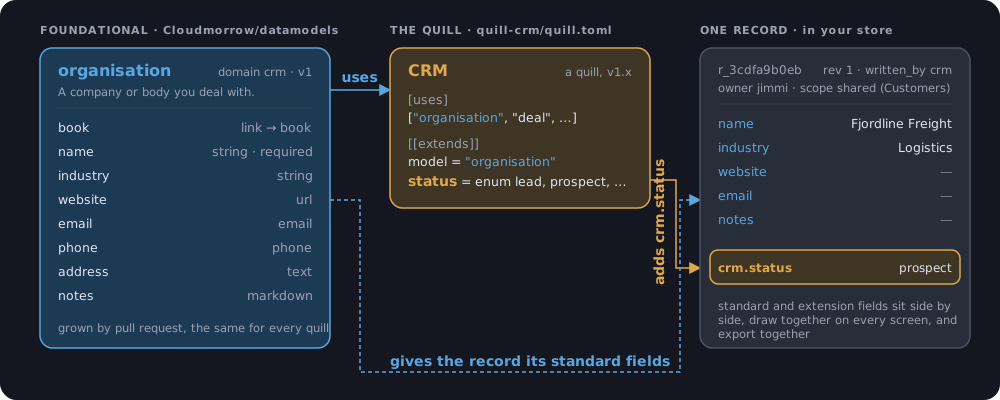
A Quill has three verbs for data, and reaches for them in this order:
| verb | in the manifest | what it means |
|---|---|---|
| uses | [uses] datamodels = ["board", "task"] |
a foundational datamodel as published; Tasks adds nothing to board and task |
| extends | [[extends]] model = "organisation" with [extends.fields] |
fields under the Quill's own name on a shape that exists, stored as crm.status; the shape stays one shape |
| introduces | a file in the Quill's datamodels/ folder |
a whole datamodel under the Quill's name, vidmorrow.clip, when nothing in the foundation fits; from then on any Quill may use it |
What the store keeps for the organisation in the picture, as the record API
returns it: the standard fields and the extension on one record, which
every screen draws together and every export writes together. Remove CRM
and the record keeps crm.status too, read-only until something writes it
again.
{
  "id": "r_3cdfa9b0eb",
  "model": "organisation",
  "owner": "jimmi",
  "scope": "shared",
  "rev": 1,
  "written_by": "crm",
  "fields": {
    "book": "r_2678732f5a",
    "name": "Fjordline Freight",
    "industry": "Logistics",
    "crm.status": "prospect",
    "website": null, "email": null, "phone": null, "address": null, "notes": null
  }
}
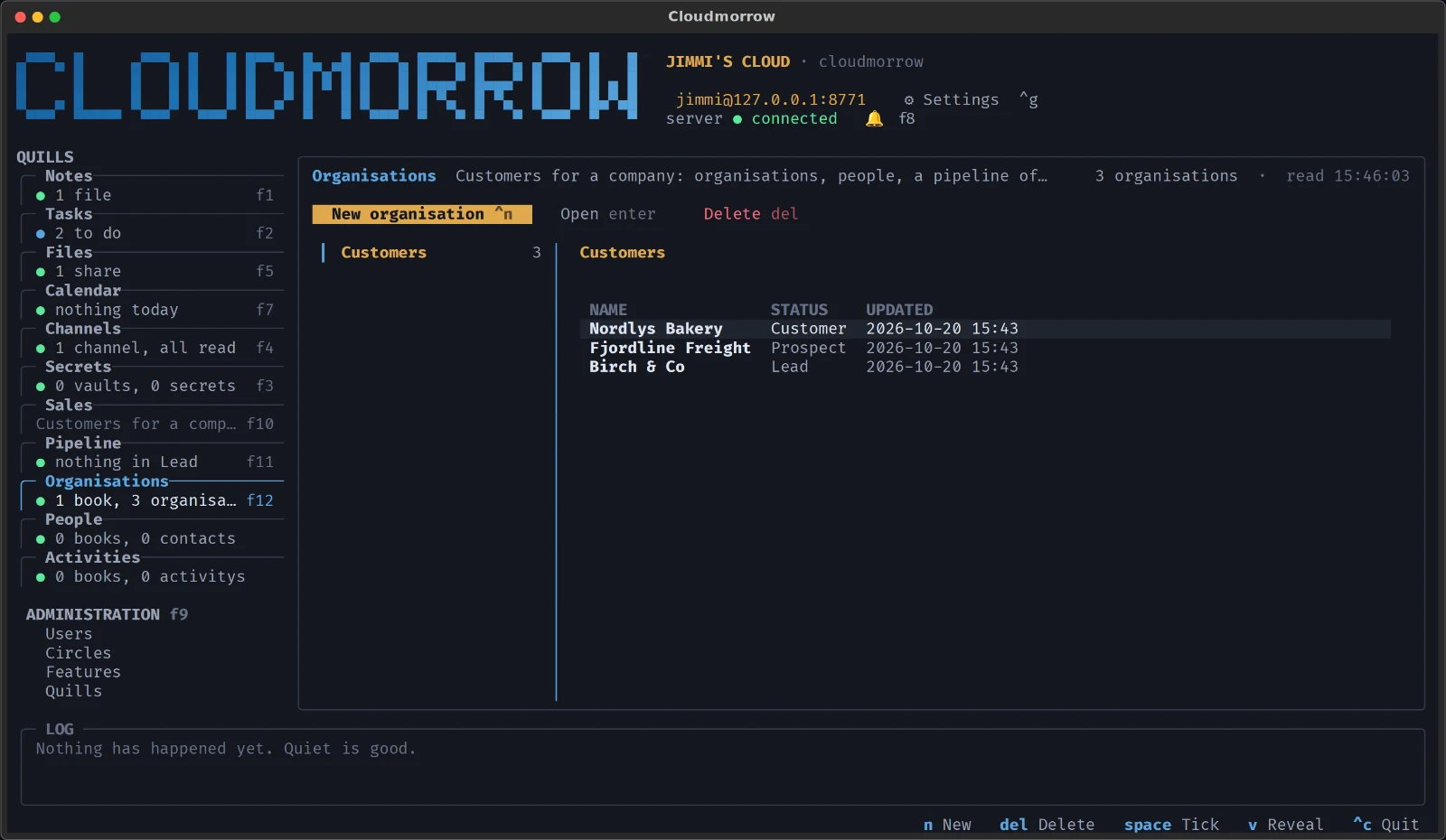
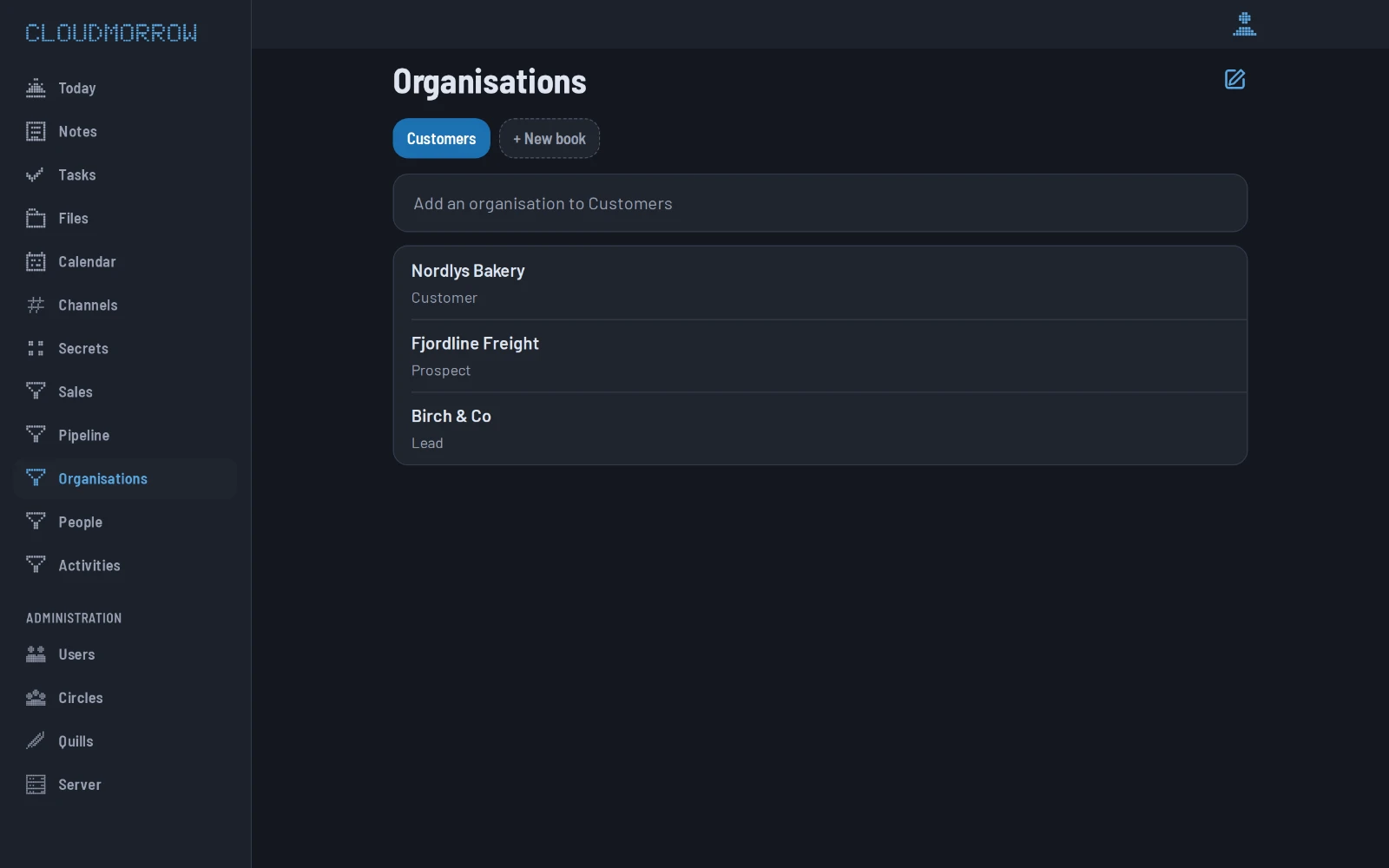
On every surface the extension field is a column like any other:
A datamodel
A datamodel is a TOML file: in Cloudmorrow/datamodels
for the foundational ones, in a Quill's datamodels/ for the ones it
introduces.
[datamodel]
id = "task"
version = 1
label = "Task"
description = "One thing to do, on a board, in a lane."
domain = "tasks"
scopes = ["personal"]
title = "title"                           # what a record is called in a list
ordered_within = ["board", "lane"]        # records keep a position inside each group

[fields]
board   = { kind = "link", to = "board", required = true, indexed = true, on_delete = "cascade" }
title   = { kind = "string", required = true }
body    = { kind = "markdown" }
lane    = { kind = "enum", values = ["todo", "doing", "done"], labels = ["To Do", "Doing", "Done"], default = "todo", indexed = true }
done_at = { kind = "datetime", indexed = true, stamp = { field = "lane", value = "done" } }
Field kinds: string, text, markdown, bool, int, decimal,
date, datetime, enum, email, phone, url, link, json. Each kind
has a widget on every surface; adding a kind means adding all of them.
datetime keeps what it was given. With a zone it is a moment, kept
with its zone; without one it is the time on the wall — 2026-10-01T10:00,
"the dentist at ten" — kept as typed, to the minute, and never converted; a
bare date (2026-10-01) is a whole day and stays one. Every client sends
what a person typed without a zone, so a calendar is on one clock. A stamp
the server sets is a moment, in UTC.
secret = true on a string or text field keeps it out of every
listing — the record store and every backend send it as null there — and
every surface draws it hidden until asked: dots and an eye on a row, a
password box on the sheet, --reveal on the command line. Reading the one
record is how its value is fetched. A secret field is never indexed.
Indexed fields are kept plain so the server can filter and sort by them. Everything else is sealed at rest under the server's key, bound to the datamodel, the owner and the record, so nothing can be moved by editing the database.
stamp sets a datetime when another field takes a value, and clears it
when the field leaves it — how a task knows when it was finished.
managed = true on a field of a datamodel that lives in a space lets
whoever manages the space change that one field on anybody's record — a
message's pinned, which the channel's manager sets on a line that is not
theirs — while the rest of the record stays its author's (authored,
below). A change that touches any other field is the author's alone.
locked says a record of the datamodel is never changed or deleted
again: locked = true from the moment it is made, or locked = { field = "status", value = "sealed", allow = ["withdrawn"] } once that enum field
takes that value, after which the one change it takes is that field moving
to one of allow, and then none. The record store refuses everything else
with 423 Locked, from every surface. Opt-in: nothing is locked unless its
datamodel says so, and only snapshot and attestation do
(ATTESTATIONS.md).
server_made = true says records of the datamodel come only from a
route of the server's own, never from the generic record API — a snapshot,
whose digest only the server can vouch for. Reading them is as any other.
Extending a datamodel is a [[extends]] table in the Quill's manifest:
[[extends]]
model = "vehicle"
[extends.fields]
odometer = { kind = "int", indexed = true }   # stored as "fleet.odometer"
Extension fields are namespaced by the Quill's id and are never required.
They are the person's, like every field: readable by anybody who may read
the record, drawn on every sheet, and written by anybody who may write the
record. A Quill's token writes only the datamodels it declared or was
granted (QUILLS.md, Grants).
Introducing a datamodel is a file in the Quill's datamodels/, with an
id under the Quill's name: fleet.service_visit. From the moment the Quill is
installed, every other Quill may ask for it.
Versions
A datamodel's version is an integer, and a released version never
changes. A foundational datamodel grows by its version: when a Quill that
needs it is installed with a newer one than the server has, the newer one
replaces it. A new version may add fields, and may keep its records in a
space (contact v2 is in a book). It never takes a field away and never
changes a field's kind: the records written before keep opening — one in
no space is still its owner's own — and a shape that needs a field gone is
a new datamodel. The Quill Catalog pins one release of the datamodels
repository, so every server installing from it agrees on the same
versions, and a server never holds two versions of one datamodel.
Records
Every record, of every datamodel, has the same envelope:
{
  "id": "r_8f2c1d0a9b",
  "model": "task",
  "owner": "alice",
  "scope": "personal",
  "rev": 3,
  "position": 0,
  "created_at": "2026-09-26T08:10:00+00:00",
  "updated_at": "2026-09-26T09:41:00+00:00",
  "written_by": "tasks",
  "fields": { "board": "r_1a2b3c4d5e", "title": "Repot the fig", "lane": "doing", "body": "" },
  "expires_at": null
}
The core serves every installed datamodel at the same API:
| call | what it does |
|---|---|
GET /api/records/{model}?field=value |
list, filtered on indexed fields, in order |
GET /api/records/{model}?field__gte=…&field__lt=… |
a range on an indexed field: __lt, __lte, __gt, __gte; a record without the field never matches |
GET /api/records/{model}?q=text |
the records whose text holds it; each found one's preview is the line that matched |
GET /api/records/{model}?previews=true |
the list, with a line of each record's text as preview |
GET /api/records/{model}?_last=50&_since=<time> |
the newest fifty, still in order; only what changed at or after a moment — a conversation's page, and what an open one has not got |
GET /api/changes |
a server-sent events stream: each record you may see being made, changed or deleted, by datamodel, id and space — never its fields. ?since=<seq> to catch up after a drop; see Keeping a screen current |
POST /api/records/{model} |
create, from {"fields": {...}}; a space also takes scope, members and unique (see Spaces) |
GET /api/records/{model}/{id} |
one record |
PATCH /api/records/{model}/{id} |
change fields; send rev to get a 409 instead of overwriting |
POST /api/records/{model}/{id}/move |
{"fields": {"lane": "done"}, "index": 0}: change group fields and position together |
DELETE /api/records/{model}/{id} |
delete, cascading along on_delete = "cascade" links |
POST /api/records/{model}/{id}/members |
{"username": …}: put somebody in a shared space (see Spaces) |
DELETE /api/records/{model}/{id}/members/{username} |
take them out; with your own name, leave |
GET /api/people |
everybody on the server a space could be shared with |
GET /api/datamodels |
every datamodel on the server, with its fields and who uses it |
GET /api/quills |
every installed Quill, with its manifest |
GET /api/quills/catalog |
the catalog, with what is installed |
POST /api/quills |
install, from the catalog or a source (admin) |
GET /api/quills/{id}/brought |
what a Quill brought — datamodels it introduced, fields it added — and how many records hold each (admin) |
DELETE /api/quills/{id}?drop= |
remove it; what drop names of what it brought goes with it, records and all (admin) |
A plain listing answers with at most a thousand records, the first thousand
in order, and says so with the header X-Records-Capped: 1000 when it
stopped there; a search answers with at most two hundred matches. Filters,
_last and _since are how a screen asks for the part it shows. Since a
record's text is sealed, a search reads and opens every row it looks at,
and stops at the last match wanted; filters on indexed fields are answered
from an index, so a screen narrows with those first and searches second.
Keeping a screen current. GET /api/changes is a server-sent events
stream (text/event-stream). It opens with event: hello and the feed's
position, then sends event: change with {"seq", "model", "id", "space", "owner", "action", "at"} for each record the caller may see
being created, changed or deleted, and : ping while nothing
happens. It never carries a field: the screen asks the record API for
what it has not got, so nothing reaches anybody that the gate would not
hand them. A client that drops comes back with ?since=<seq> and gets the
changes it missed of the last few thousand; ?limit=N closes the stream
after N, for a script. The web app's thread screen listens this way and
falls back to asking every few seconds while the stream is down
(web/changes.js).
Scopes are personal, shared and public, as chat and calendar have them.
Records of a datamodel that is not a space, and not in one, are personal:
their owner's alone. So is a record of a datamodel that lives in spaces when
its space link is left empty — a contact in no book is your own address
book's. See Spaces for everything shared.
Spaces: what more than one person shares
A calendar the household shares and a channel the team talks in are the same shape: a container some people are in, and things inside it that everybody in it may see. The record store has that shape once, for every Quill, as spaces.
[datamodel]
id = "calendar"
space = true                      # a record of it is a space
scopes = ["personal", "shared", "public"]

[datamodel]
id = "event"
in_space = "calendar"             # a link field: whoever may see the calendar sees the event
| scope | who sees it and writes in it | who manages it | leaving |
|---|---|---|---|
personal |
its owner | its owner | cannot |
shared |
its owner and its members | its owner, and administrators | a member may |
public |
everybody on the server | its owner, and administrators | nobody can |
A space's scope is set when it is made, and a shared one may be made with
its people in it ("members": [...]). Members are added with
POST /api/records/{model}/{id}/members and removed with DELETE …/members/{username}; being added leaves a notification. "unique": true
finds the space of that datamodel with exactly you and members in it, and
the same indexed fields, before making one (200 rather than 201) — the one
conversation between two people, from either side; its people are not told
they were added, because the first thing written in it tells them.
GET /api/people is everybody else there is to share with. A record in a
space is sealed to the space, so moving a message to another channel by
editing the database opens as nothing.
A dataset can seed a space once per server (seed = "once", for the
public calendar and #general) or once per person (seed = "per-owner",
for everyone's own calendar). A dataset of a datamodel in a space can be
seeded once in every space that has none of it (seed = "per-space"): the
CRM's pipeline stages, in every book, the first time a book's stages are
read — so a book made later gets them too, and there is never a book
without a pipeline.
A space link is on_delete = "cascade": what is in a space goes with it.
clear is refused, because a record sealed to a space it no longer names
could not be opened.
Being able to see a space is being able to write in it. Who may change
or delete what is written there is the datamodel's authored:
authored |
who changes and deletes a record | for |
|---|---|---|
false (the default) |
anybody who may see it | a shared list |
true |
only whoever wrote it | a message |
"or-manager" |
whoever wrote it, or whoever manages its space | an event: the calendar's maker can clear somebody's stale one |
A space may declare what happens when something is written in it:
[[notify]]                        # on the datamodel of what is written
when = "created"
to = "members"                    # everybody in the space but the writer
push = true                       # and a push to their phones
unread = true                     # counted until they open the space
Backends: data that lives somewhere else
Most datamodels live in the record store. Three foundational ones live where they always have, because other things reach them there, and are served through the same record API by a backend:
| datamodel | backend | lives in | also reached by |
|---|---|---|---|
share, file |
shares |
the fileshares and each person's drive | WebDAV, the desktop app's mounts, cm share, /api/shares |
secret |
vaults |
the secrets store, sealed under its own key | cm secret run, and never an assistant |
A backend answers the same list, get, create, change and delete, with the
same envelope, so a Quill, cm <quill> and an assistant cannot tell the
difference. The Notes, Files and Secrets Quills carry only their screens. A note is
not a datamodel: it is a Markdown file in the Notes folder of a drive,
and Notes is an editor over file within it — where = { share = "my-files", within = "Notes" }, suffix = ".md" — which is what any Quill
over text files declares.
q and previews are not filters, and every listing takes them: the record
store searches the text fields it unseals, and a backend searches its own
way (notes read their files, names and every line). A backend may do two
things more, and a datamodel says which in can beside it in
GET /api/quills — ["search", "folders", "attachments"] for a note:
| capability | calls | what it is |
|---|---|---|
folders |
GET, POST {path}, PATCH {path, to}, DELETE ?path= on /api/records/{model}/_folders |
folders a record's path is in, which exist before anything is put in them and take everything in them when they go |
attachments |
POST (the body is the file) and GET …/{name} on /api/records/{model}/_attachments |
files kept beside the records; the answer's path is what Markdown writes () |
A folder is not a record: it has no fields, no rev and nothing to seal, and
a listing of notes with folders in it would be a listing of two things. So
it is a capability a backend declares by having the methods, and any other
backend with folders — the fileshares — answers the same calls.
A backend may also keep content: bytes beside a record's fields. The
shares backend does — a file's — and the record API has three more calls
for any datamodel whose backend keeps some:
| call | what it does |
|---|---|
GET /api/records/{model}/{id}/content |
the bytes, as themselves |
GET /api/records/{model}/{id}/export?as=pdf |
a document as Word, PDF, Markdown or .docs, a sheet as Excel, PDF, CSV or .cell, to save (docs/DOCS.md, docs/CELLS.md); 400 for anything else |
GET /api/records/{model}/{id}/thumb?size=256 |
a small JPEG of a picture; 415 when it is not one the server can scale |
POST /api/records/{model}/upload?field=value… |
a new record from the body's bytes, the query saying where and what it is called |
POST /api/records/{model}/{id}/copy {fields} |
a copy of a file, or of a folder and all in it, where the fields say (share, folder, name, each the original's unless said); nothing said is a duplicate beside it, and a taken name is numbered. A backend that copies says copy in can |
A share's id is its name (my-files for the person's own drive); a file's
is the share and the path in it, encoded, and it is listed a folder at a
time: GET /api/records/file?share=my-files&folder=Photos. Making a file
record with kind = "folder" makes a folder; changing its name, folder
or path renames or moves it inside its share.
Access: who may see it, who may change it
The whole of it, in six lines. The screens are in CIRCLES.md.
- Access is none, read or write, on a datamodel, given to a circle or to one person. Nothing finer: there is no rule on a field. A person's access is the most any of their circles, or their own rules, gives.
- No access, no Quill. A Quill over data you may not reach is not on your phone. Read only, and the Quill is the same screen looked at: no new, no edit, no dragging, no composer. Write, and it is yours to change.
- A new Quill's data is everyone's, read and write, by default. A fresh
server's one circle has
* = write, so a datamodel that arrives with a Quill is open to all; the install sheet is where an administrator narrows it before saying yes, and the circles screen is where it is narrowed later. - A space is what some people share: personal, shared with named
members, or public. Seeing a space is writing in it; who may change a
particular line in it is the datamodel's
authored. - One gate. Every read and write, by a person, a Quill's code or an
assistant, passes the same check of principal, action, datamodel and
scope, and an assistant never reaches
secret. - Everything is logged. Every create, change and delete of a record
keeps who, when, and which fields were touched — never a value — for as
long as the record lives (a deleted record's lines serve the change feed
ninety days more, then go). A record's sheet shows it on every surface,
cm <quill> history <record>prints it, and an assistant asksget_record_history. People act under responsibility, and responsibility is visible.
What is next
Agreed on 8 October 2026, after setting an outside proposal for a "foundational datamodel specification" against what is built. Most of what it asked for exists in a smaller shape — the registry, versions, domains, the envelope, scopes, extensions, datasets, the change feed — and the gaps are in the claim itself: who may change a record is only half said, reference data is free text, and the foundation is narrow. Each phase ends with something a person can use.
Phase 1 — who may change it, said in full — was built on 8 October 2026: access for a person as well as a circle, the install sheet saying who gets a Quill's data, a record's history on every surface, and the remove sheet asking about what a Quill brought. All of it is under Access and Two kinds above. Left out on purpose: hiding one field from some people, a guardian reading a child's personal records, and access by time.
Phase 1 — Lists and kinds
Reference lists in the datamodels repository, lists/<id>.toml: a list of
{ value, label } with an optional deprecated flag, versioned with the
repository. An enum field may say values = "@currencies" instead of
listing its own. book.currency and deal.currency move to it in their
next versions; country arrives on contact and organisation the same
way. A list is a picker on every surface, which enums already are, so no
new widget. Start with currencies and countries; units and languages when a
Quill asks.
A money kind (amount and currency together) is the one value type worth
its widget on five surfaces. Decide it after the lists land, when deal
shows what a decimal and a separate string cost in screens.
Done when: a deal's currency is picked, not typed, and a list changes by pull request without a datamodel version.
Phase 2 — Broaden the foundation
The foundation grows to every domain we know, in the datamodels repository, decided and written by us. The breadth is the point: a freelancer, a shop, a household and an association should each find their domains here and need extended datamodels only for what is peculiar to them. The datamodels of all the domains below were written on 8 and 9 October 2026 (datamodels v1.5.0 and v1.6.0); what remains is a Quill of ours for each, so the shapes are proven on a screen, Home first. In order of who asks:
| domain | datamodels | reuses |
|---|---|---|
| Home | item (name, quantity, unit, where, photo), expense (amount, when, who, category, receipt) |
contact |
| Projects | project (a space), time_entry; task v2 gains project |
task, contact |
| Products and services | product, service, price |
book |
| Invoicing | quote, invoice, line — an issued document keeps its lines as written, whatever changes later |
organisation, contact, book |
| Membership | association (a space), membership (from, to, kind), donation |
contact |
| Fundraising | campaign, pledge; donation gains campaign |
contact, organisation |
| Events | registration, attendance; event gains a place |
event, contact |
| Purchasing | supplier (an organisation link), purchase_order, receipt |
organisation, product |
| Inventory and assets | stock_item, storage_location, stock_movement, asset, maintenance |
item, place |
| Workforce | employment, team (a space), leave |
contact |
| Agreements | agreement, obligation |
organisation, contact, file |
| Accounting | ledger (a space), account, journal_entry, posting, tax_rate, bank_account, bank_transaction, budget — a basic ERP's finance core |
— |
| Media bank | library (a space), media_item, collection, collection_item, licence |
organisation |
| Creative work | brief, deliverable, review, in a project |
project, contact, media_item |
Payroll, health and anything a regulator has an opinion on wait for somebody with the domain in their hands; accounting is the books and nothing a tax office would sign. What a Quill needs outside all of this is its own extended datamodel, and that is where it stays unless we judge the domain is ours to know. Home goes first because the catalog's Home shelf is empty now that Channels, which replaced Chat, stands in Business.
Kept out, on purpose
- Party, PartyRole, ContactPoint, PartyAddress and the rest of the
normalised identity model. A person who is a customer and a volunteer is
one
contactin two books, or one contact with two Quills' extension fields on it. A typed link says what a Party reference would, with one table fewer. - Semantic versions, lockfiles, side-by-side majors. Integers, pinned by the catalog, additive only.
- Dataset provenance with checksums and licence review. The lists we need are short, are facts, and are typed into a TOML file reviewed by pull request like any field. (A snapshot of a space, with a digest and a signed attestation on it, is a different thing and is built: ATTESTATIONS.md.)
- Permissions per field, retention policies, legal holds, governance packs. Access that is a spreadsheet is not delightful, and nobody on one box asks for it. The control that keeps data safe is three words on a datamodel and a log of who did what.
- Export and import. Not needed until there is somewhere to take the data. The sealed database and its key are the backup, and the record API hands out every record as JSON today. When a hosted tenant exists, leaving it must be easy on that day, and that is when a whole-server export arrives, with each datamodel naming its format (vCard for a contact, iCal for an event, CSV for anything flat).
- Installation profiles as a fourth kind of thing. If wanted, a named tick-set in the catalog, not a layer.
- Reviewed merges of duplicate contacts. A real wish, later, as a Quill action.
From docs/DATAMODELS.md in the Cloudmorrow repository. Something wrong? A pull request there fixes it here.