
Think about where your stuff is right now. Your notes are in one company's app. Your photos are in another's. The family calendar is in a third, the club's member list is in a spreadsheet somebody emailed around, and your passwords are wherever the browser put them. Each of those companies holds the one thing that actually matters, your data, and you rent access to it a month at a time.
I spent the autumn building the opposite of that. It is called Cloudmorrow, and this is the first time I am writing about it for anybody but myself.
One small computer, everything in it
Cloudmorrow is a program you install on a computer you own. A Raspberry Pi on a shelf. The old laptop in the drawer. A cheap rented server, if you prefer. One command installs it, it asks six questions, and then it is running.
From that moment everyone in your household, your club or your small company has an account on it. They get an app on their phone, the same app in a browser on a laptop, and, for the people who like that sort of thing, a terminal app and a command line. Notes, tasks, a calendar, files, group chat and a place for passwords come in the box.
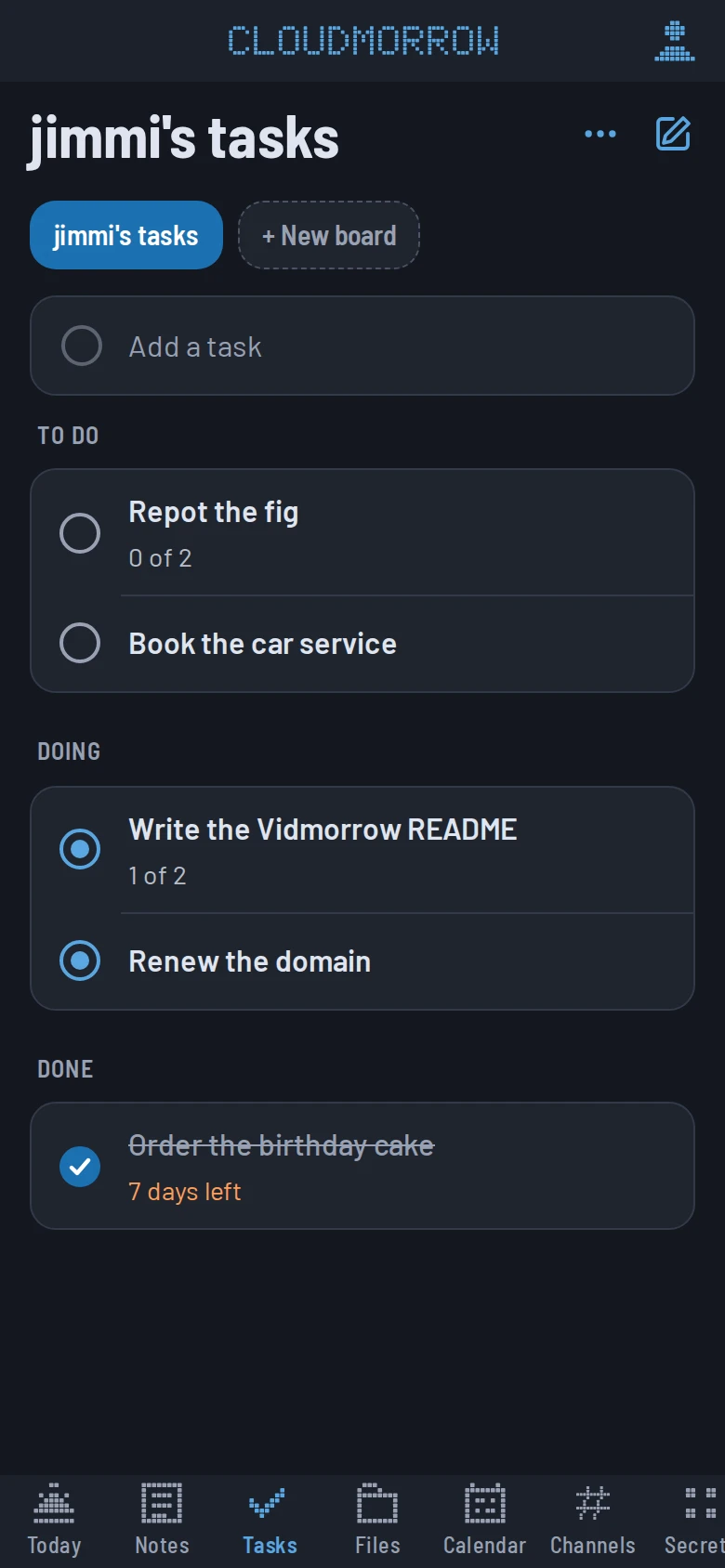
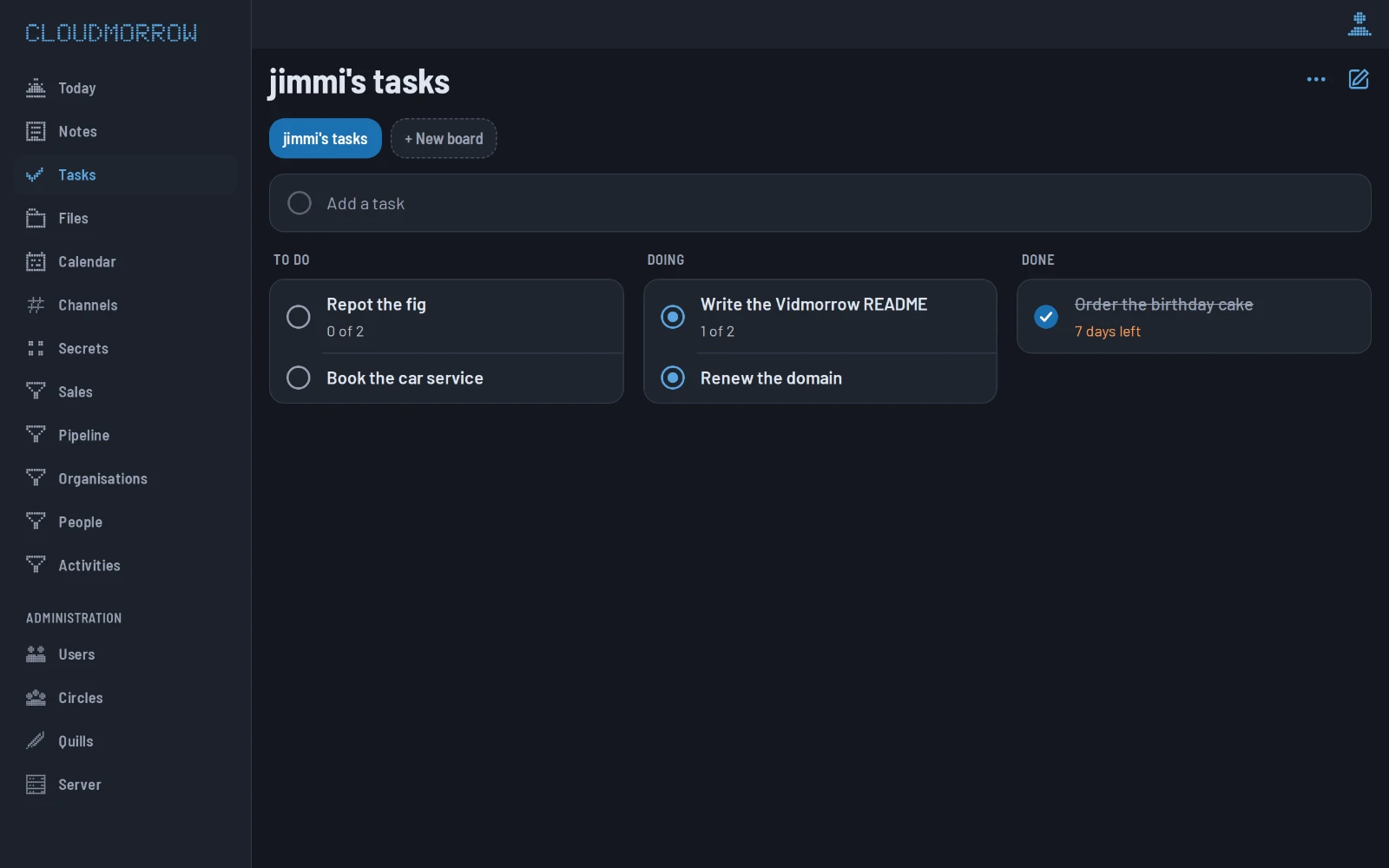
Everything anyone writes is scrambled before it touches the disk. If someone walks off with the hard drive, they walk off with noise.
The part that is actually different
Plenty of software lets you host your own files. What makes Cloudmorrow unusual is how it treats apps.
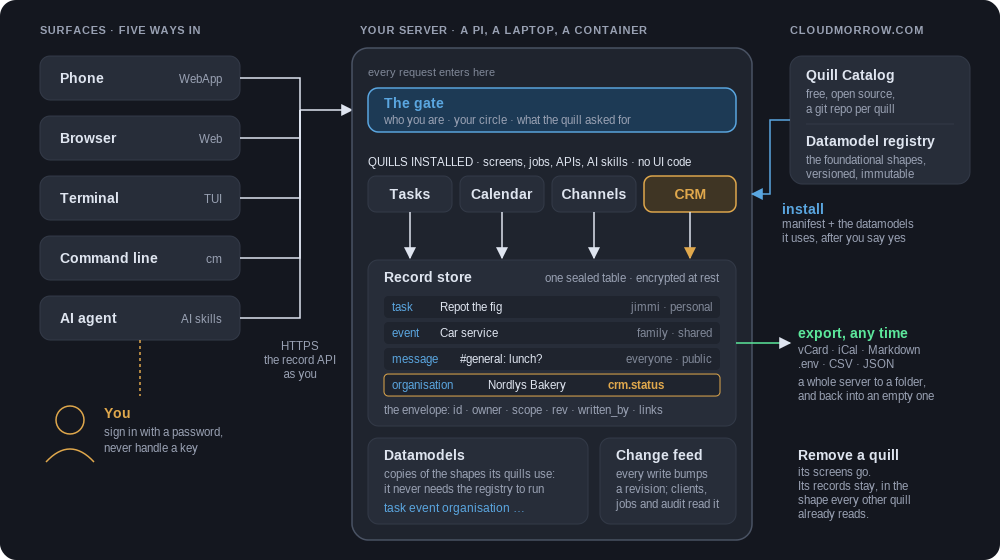
In most systems each app owns its data. Delete the app and the data goes with it, or comes out in a format nothing else can read. Cloudmorrow puts the data at the bottom, in standard shapes that every app agrees on. A note is a note. A task is a task. A contact is a contact, whichever app made it. The apps, which I call Quills, sit on top and only touch what they ask for.
So you can throw an app away and keep everything it worked with. You can install a new one and it already sees your contacts, your events, your files. The data is the part that lasts. The software is the part you change.
Apps with no screens of their own
Here is the bit that took me longest to get right, and that I think matters most.
A Quill does not contain any code for drawing screens. It is a short description: "I use tasks. Show them as a board with these three lanes. The card shows the title." Cloudmorrow reads that and draws the board on the phone, in the browser, in the terminal, and even as commands you can type. The same description also tells an AI assistant exactly what the app can do, so you can ask it to add a task for you.
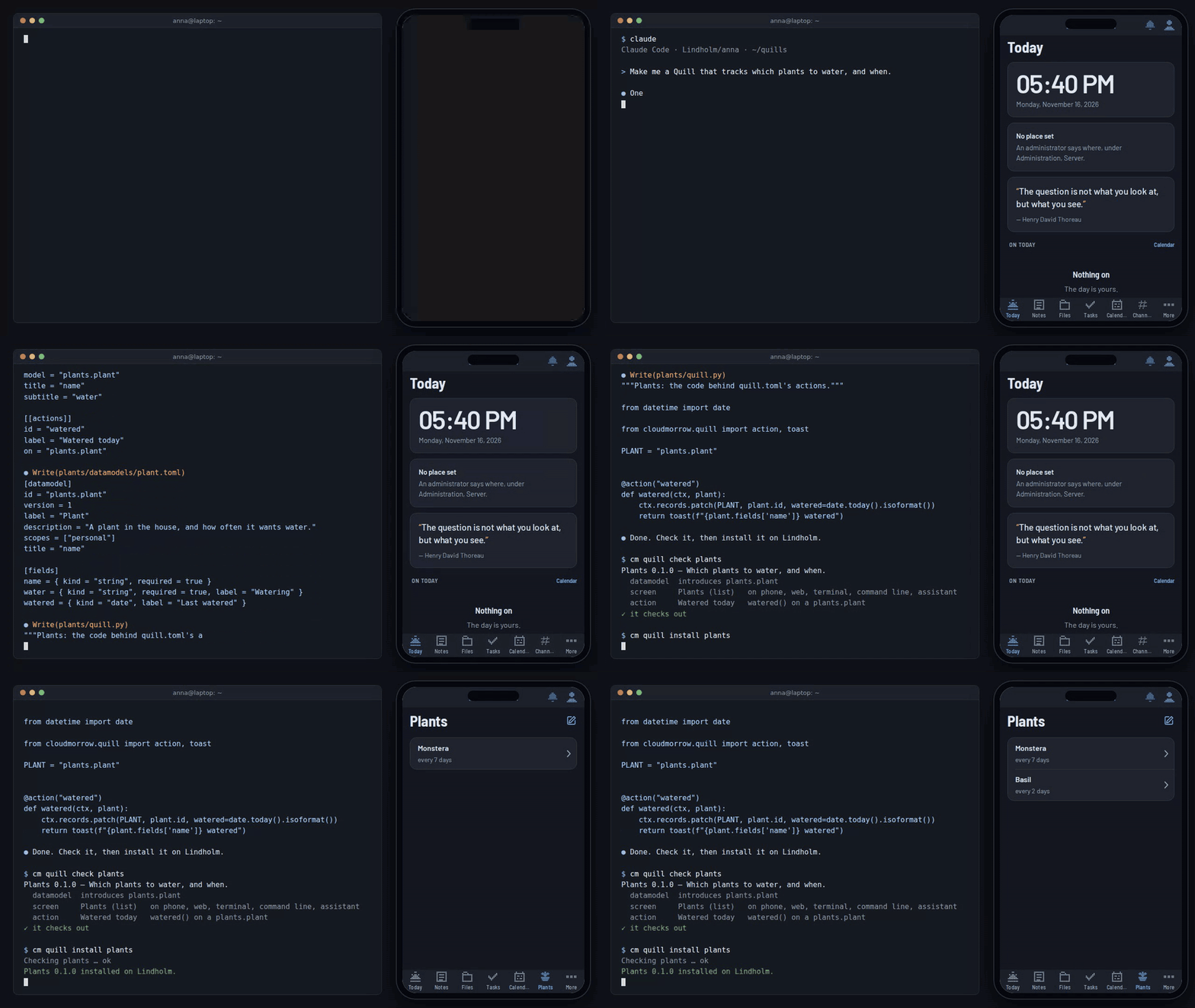
Because a Quill is just a description, it is small. Small enough that you can ask an assistant like Claude to write one for you in an afternoon, and it works everywhere the first time. I recorded that happening:
What you get today
In the box: Notes, Tasks, Calendar, Files, Channels for chat, and Secrets for passwords. From the catalog, with one click: Docs, a word processor that reads and writes Word files. Cells, a spreadsheet that opens Excel files. Media, your photos on a wall. CutMorrow, a video editor. Mail, a CRM for a small business, a tool for developers' projects, and Morrow, an assistant that lives inside your cloud. Daily backups to any storage bucket, with any single file recoverable as it was on any day.
What you do not get yet
I would rather say this myself than have you find out. There is one person behind this, me. The app that mounts your files as a drive on your computer only works on Linux so far; on a Mac or Windows you use the browser. There is no button yet that pulls your things out of Google or Nextcloud. There is no corporate single sign-on. And it is seven weeks of public releases old, which means rough edges, and also means fixes land within days.
Try it
One line, on any Linux machine:
curl -fsSL https://raw.githubusercontent.com/Cloudmorrow/cloudmorrow/main/deploy/install-server.sh | sudo sh
The script is short, and I would honestly rather you read it before you run it. There is a Docker version too. The install page has the details.
All the code is public at github.com/Cloudmorrow, free software, forever. If something breaks, tell me. If you build something, show me. I read everything, the same day.
By Jimmi Bram. Something wrong? The posts are files; a pull request fixes it.